The following sections describe requirements for individual Role Types.
Each Role Type has requirements categorized in the following subsections:
Protocol Requirements
Setup
Runtime Configuration
Runtime Communication
The Setup subsection describes the specific requirements for a given Role Type
during and after a network inclusion.
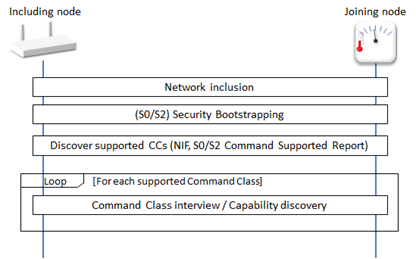
Figure 8.13 shows the different steps
of a node setup / commissioning.
The network inclusion process is described in Inclusion Process.
Additional recommendations are given for the different Role Types.
(S0/S2) Security bootstrapping
The security (Security 0 or Security 2) bootstrapping takes place immediately
after the network inclusion. Refer to Section 4.
Discover supported Command Classes
The controlling node reads the supported command classes before interviewing
each of them.
Command Class interview
Each role type specifies some requirements that must be observed during the
Command Class interview:
Lifeline configuration::
\requirement{RT:00.11.0037.1}{8}
When interviewing the Association or Multi Channel Association Command Class,
the including controller sets up the lifeline association if it is the SIS.
If a SIS is present in the network, the destination NodeID of the Lifeline
group MUST be the SIS NodeID. Requirements are detailed for each Role Type
in the following sections. Refer to [35] and Section 7 for Lifeline group definition
Battery considerations:
Some requirements apply for battery powered nodes, supporting the
Wake Up Command Class. Details are given for each Role Type.
Commissioning and runtime phases
The commissioning phase is defined as the period after a node’s inclusion
during which the Security bootstrapping, Lifeline configuration, Wake Up
configuration and initial device interview is made by a controller.
\requirement{RT:00.12.0008.1}{0}
It is RECOMMENDED that a controller does not display a newly included node as
ready to be operated during the commissioning phase.
The commissioning phase is considered over when the initial interview is
completed or latest 10 minutes after the network inclusion.
Once the commissioning phase is over, a node is said to be in the runtime phase.